In real estate, there is a golden rule: location, location, location. What applies to buildings also applies to retail and fashion. The right location can make a brand -- the wrong one can break it.
Prime Locations: What Do They Mean?
- Prime location: The absolute top location of a city -- main shopping street, highest foot traffic, highest rents.
- Secondary location: Side streets off the main shopping street -- somewhat less traffic but significantly lower rents.
For luxury brands, a prime location is mandatory -- not because of in-store revenue, but because of visibility. A Gucci store on a prestigious boulevard is primarily a statement: "We belong here."
Flagship Stores: More Showroom Than Shop
Apple Fifth Avenue, New York
The iconic glass cube on Fifth Avenue is the most famous retail building in the world. The store itself is profitable -- but its true value lies in its symbolic power.

Nike House of Innovation, New York
Six floors, 6,300 square meters, packed with technology. The store is less a shop than an experience center.
Gucci Garden, Florence
Half museum, half store, completely Gucci. According to Cushman & Wakefield, the Gucci Garden is one of the best examples of "retailtainment."
Pop-Up Stores: Temporary Locations, Permanent Impact
Pop-up stores are the democratic alternative to flagship stores. Benefits: flexibility, FOMO effect, content machine, and market research.
Google Maps SEO: The Digital Location
The physical location is only half the equation. Google Business Profile is the most important location marketing tool.

According to CBRE, 76 percent of smartphone users who search locally visit the business within 24 hours. Local SEO is thus one of the highest-converting marketing channels of all.
Footfall Analysis Tools
- Placer.ai: Analyzes anonymized mobile data showing visitor flows and dwell time
- Google Maps Platform: Frequency data and peak times for any location
- RetailNext: Sensor-based in-store analysis with heatmaps

Geofencing and Digital Location Targeting
Location marketing has expanded beyond physical addresses. Geofencing turns any real-world location into a digital trigger zone. A geofence draws a virtual perimeter around a specific area -- a competitor's store, a trade show, a stadium, or your own location. When a mobile device enters the zone, targeted ads are activated.

Use cases for geofencing:
- Competitive conquesting: Target users entering competitor locations with your offer
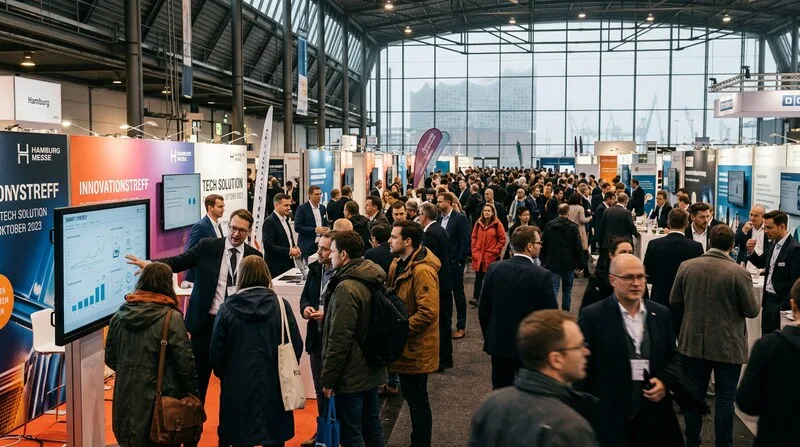
- Event targeting: Reach trade show visitors who are currently on-site
- Loyalty reinforcement: Reward existing customers when they are near your store
- Behavioral retargeting: Retarget users who visited specific locations (e.g., gym visitors for a sports brand)
Under GDPR, geofencing requires consent-based audiences via apps or opt-in programs. Contextual signals -- neighborhood, venue type, time of day -- can supplement device-level targeting for compliant campaigns. Read more about how digital and physical channels integrate in our guide to Cross-Channel Campaigns.
The Cost of Location: A Benchmark Guide
Understanding location economics is essential before any retail or marketing decision. Benchmark cost ranges for German and European urban markets:
| Location Type | Cost / m² / Month | Best For |
|---|---|---|
| Prime high street (Munich/Berlin/Hamburg) | €150–400 | Premium brand statement, flagship |
| Secondary high street (adjacent streets) | €50–120 | Established brands, efficient footfall |
| A-grade shopping center | €80–200 | Retail with guaranteed footfall |
| Pop-up (1–4 weeks, short-term) | €500–5,000/week | Brand activations, product launches |
| Airport concourse | €300–600 | Premium audience, high international exposure |
| Industrial / Fringe (B-lage) | €10–40 | Logistics, wholesale, destination brands |
Google Business Profile Optimization Checklist
For most local businesses, Google Business Profile (formerly Google My Business) is the single highest-ROI location marketing tool. 76% of users who search locally visit the business within 24 hours. Here is what a fully optimized profile requires:

- Complete all profile fields: Business name, address, phone, website, hours, category, and attributes. Incomplete profiles rank lower in local pack results.
- Add 20+ photos: Profiles with photos receive 42% more requests for directions and 35% more website clicks than those without.
- Collect and respond to reviews: The average Google Business Profile in Germany has 12 reviews. 50+ reviews with responses increases local ranking significantly.
- Use Google Posts weekly: Offers, events, and product posts keep the profile active and provide additional keyword signals.
- Enable messaging: Users increasingly prefer to message businesses directly — enabling this feature adds a conversion touchpoint.
- Add Products/Services: These appear in the knowledge panel and provide additional keyword indexing for your category.
- Monitor Q&A: Anyone can answer questions on your profile — own the narrative by answering proactively and seeding important FAQs.
For pure brand visibility without long-term sales targets, a pop-up in a prime location for two to four weeks often delivers better ROI than a long-term lease at a secondary address. The brand association of a prime address far outweighs the efficiency of cheaper square footage. Apple does not open stores in secondary locations -- ever. That restraint is itself a marketing decision.
Conclusion: The Right Location Is Priceless
In a world going digital, the physical location remains an irreplaceable brand factor. A flagship store on a prestigious avenue communicates differently than an online shop. Location is not just a logistical factor -- it is a marketing statement. For brands that combine physical presence with digital precision, the intersection creates compound advantage: each channel amplifies the other. The store builds brand trust; digital extends reach; the two together compound into a customer acquisition loop that neither delivers alone. This integration is central to any cross-channel campaign strategy.
Frequently Asked Questions: Location Marketing
What is location-based marketing?
Location-based marketing uses a customer's geographic position to deliver relevant advertising, offers, or content. This includes geofencing (targeting users within a defined radius), geotargeting (delivering ads based on city or region), beacon technology (push notifications to users near a physical store), and Google Maps advertising (showing up for "near me" searches). The common thread: relevance through proximity. A user searching for "coffee shop near me" at 8am on a Monday has a very different intent signal than the same search at 10pm on a Saturday.

How much does a prime retail location cost in Germany?
Top-tier retail rents in Germany vary significantly by city: Munich's Kaufingerstrasse runs €350–500/m²/month; Frankfurt's Zeil €200–350/m²/month; Berlin's Kurfürstendamm €150–250/m²/month. Secondary high streets cost 30–60% less. For brands not ready to commit to a permanent lease, pop-up locations can be secured for €5,000–50,000/month in prime areas — a fraction of the annual commitment. The ROI equation: what brand value does the location create vs. what it costs per customer acquired.
What is geofencing in marketing?
Geofencing creates a virtual boundary around a physical location — a store, a competitor's store, a stadium, or a trade show venue. When a user with a mobile device enters this zone, they can receive targeted ads, push notifications (if they've opted in to an app), or coupons. Geofencing campaigns targeting competitor locations (known as "conquesting") can intercept high-intent customers at precisely the moment they're evaluating alternatives. Combined with retargeting, geofencing creates highly efficient location-driven customer acquisition funnels.