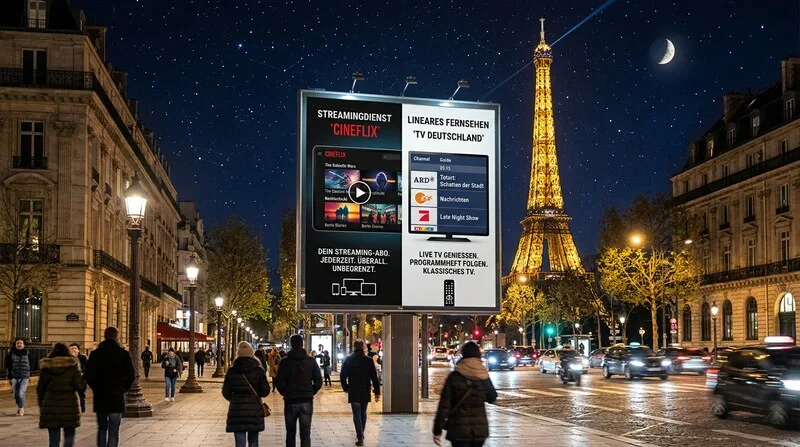
Primetime has shifted. Instead of sitting in front of linear TV at 8:15 PM, audiences are on the couch with Netflix, scrolling through YouTube, or listening to Spotify. Streaming advertising is the fastest-growing ad market -- and brands that get in now secure an advantage.

The Streaming Market in Numbers
Over 80 percent of 18-to-49-year-olds use at least one streaming service. Average usage exceeds two hours daily. For advertisers, this means: reach is migrating to where the content is.
Netflix with Ads: The Game-Changer
When Netflix introduced its ad-supported tier in 2022, the market changed fundamentally. Netflix advertising offers what linear TV cannot: precise targeting by interests, demographics, and even viewing habits. CPM ranges from 35-50 euros -- more expensive than YouTube, but in an environment that forces attention (no skip option).

YouTube: The World's Largest Video Platform
YouTube is the second largest search engine after Google. For brands, YouTube offers pre-roll ads (skippable after 5 seconds), bumper ads (6 seconds, non-skippable), and mid-roll ads. YouTube advertising with an average CPM of 10-20 euros is significantly cheaper than TV.
Spotify: Audio Advertising for the Ears
Audio advertising is experiencing a renaissance. Spotify reaches over 600 million users worldwide. Audio ads have a crucial advantage: no banner blindness. Spotify offers podcast ads, music interruptions, and sponsored playlists. Especially interesting: mood targeting.
Twitch: Reaching the Gaming Generation
Twitch is the leading live streaming platform with over 30 million daily users. For brands outside the gaming industry, Twitch is still largely untapped -- and that is precisely the opportunity.
Connected TV (CTV): The Star Among Formats
CTV -- advertising on smart TVs via apps -- is according to IAB the fastest-growing ad format worldwide. It combines the impact of TV (big screen, lean-back experience) with the precision of digital (targeting, measurability). CTV advertising has a completion rate above 90 percent.

Product Placement: The Elegant Alternative
Product placement in streaming series is subtler and more effective than traditional advertising. "Emily in Paris" generated millions for brands like Vespa, Dior, and Rimowa -- without a single commercial. According to The Trade Desk, viewers remember product placements in streaming series three times better than traditional TV advertising.
Streaming CPM vs. Traditional TV: The Budget Decision
Budget planning for streaming vs. linear TV comes down to one question: do you need reach or quality? Here are the numbers that inform the decision:

| Platform | CPM (EUR) | Key Characteristics |
|---|---|---|
| Linear TV (Primetime) | 8–20 EUR | Mass reach, broad targeting, limited measurability |
| Netflix Ads | 35–50 EUR | Premium context, non-skippable, 100% completion rate |
| DAZN | 20–40 EUR | Live sports context, high engagement, male 25–44 skewed |
| YouTube Pre-Roll | 10–20 EUR | Vast reach, skippable after 5s, strong targeting options |
| Amazon Prime Video | 20–35 EUR | Purchase-intent audience data from Amazon shopping history |
The rule of thumb: streaming costs more per impression but delivers better quality impressions. A non-skippable Netflix ad in a premium content environment is worth 3-4x a skippable YouTube pre-roll in terms of brand recall. For audiences under 45, the switch has already happened — streaming-first is the right allocation for 2026.
For the full picture on how streaming fits into a broader media mix, our German guide on Streaming vs. lineares TV covers the full platform comparison with German market data, and our marketing budget guide shows how to allocate media spend across all channels.

How to Plan Your First Streaming Campaign
Starting with streaming advertising is less complicated than most media buyers assume. A practical checklist for your first streaming campaign:
- Define the objective precisely: Streaming works best for brand awareness and upper-funnel engagement. If the goal is direct conversion, pair streaming with retargeting on performance channels.
- Choose 1-2 platforms to start: Don't spread budget across five platforms simultaneously. Start with YouTube (widest reach, most targeting options) or Netflix/CTV if premium brand positioning is the priority.
- Produce format-specific creative: A 30-second linear TV commercial will underperform on streaming. Native, platform-aware creative -- shorter, mobile-friendly, designed for sound-on or sound-off -- consistently outperforms repurposed TV assets.
- Set up brand lift measurement: All major streaming platforms (YouTube Brand Lift, Nielsen Streaming, Kantar) offer brand lift studies. Running one on your first significant campaign gives you baseline data that compounds in value over time.
- Allocate at least 8 weeks: Streaming campaigns need time for frequency accumulation. Single-week bursts are less effective than sustained lower-frequency exposure over 6-10 weeks.
Budget guidance: meaningful streaming campaigns start at EUR 5,000-10,000 per platform. Below this threshold, the reach is too limited for statistically significant measurement. See also: Marketing Budget Guide for allocating streaming within a full-funnel media mix.
Conclusion: Streaming Is the New Normal
The question is no longer whether streaming advertising is relevant -- but how quickly brands make the switch. The future of advertising is on-demand, personalized, and measurable. The new primetime is anytime. Early movers are already securing premium inventory at lower CPMs — and building the measurement infrastructure that will define competitive advantage in the next five years. For brands shifting budgets from traditional to digital, understanding performance marketing trends in 2026 provides the broader context for where streaming fits in the full-funnel media mix.
Frequently Asked Questions: Streaming Advertising
How much does advertising on streaming platforms cost?
Streaming ad costs vary significantly by platform and format. Connected TV / CTV ads (Netflix, Disney+, Prime Video): CPMs typically €15–40 in Germany — premium due to high-quality viewing context and audience data. Audio streaming (Spotify): €8–18 CPM for audio ads, €15–30 for video takeovers. Podcast advertising: CPMs of €20–50 for mid-roll placements on popular podcasts. Video-on-demand pre-rolls: €10–25 CPM. These rates are significantly higher than social media CPMs (€3–12 on Meta) but deliver a lean-back viewing context that commands much higher attention and brand recall.

What is CTV (Connected TV) advertising?
Connected TV advertising delivers ads through internet-connected television screens — Smart TVs, streaming sticks (Fire TV, Chromecast), gaming consoles, and streaming apps (Netflix, Disney+, RTL+, YouTube on TV). Unlike traditional TV, CTV allows precise digital targeting: you can target by age, income, interests, geographic area, and behavior — while reaching viewers on the largest screen in their home. CTV is growing rapidly: in Germany, 72% of households have at least one connected TV device (2025), and Netflix, Disney+, and Amazon Prime Video now all offer ad-supported tiers reaching tens of millions of users.
Are streaming ads more effective than TV ads?
Streaming ads outperform traditional TV on three dimensions: targeting precision (you can reach a defined audience segment vs. broad demographic estimate), measurement (digital attribution tracks ad exposure to website visits and purchases), and efficiency (no waste on viewers outside your target). Traditional TV outperforms streaming on raw reach (still the fastest way to reach the full German population at scale) and premium brand context (major live events like sports and news still draw large simultaneous audiences on linear TV). The winning strategy for large brands: use linear TV for peak reach moments; use streaming/CTV for precision targeting year-round.